
How Art Changes the Atmosphere of a Room

How Art Changes the Atmosphere of a Room
Have you ever walked into a room that looked perfectly fine, with nice furniture, good light and everything in its place, and yet something felt missing?
Very often, that missing element is art.
A room can be functional and well designed but still feel a little impersonal, like a hotel room or a furniture showroom. Then a painting goes up on the wall, and suddenly the space has a mood, a centre and a personality.
It’s remarkable how much difference a single artwork can make. The same wall, the same sofa, the same light, and yet the room feels completely different. In this post I’d like to explore why that happens, and how you can use art to shape the atmosphere of your own space.
A blank wall is not neutral
We often think of empty walls as neutral, a safe choice. But a blank wall also says something. It can make a room feel unfinished, cold or temporary, as if nobody has quite settled in yet.
Art fills that silence. It gives the eye something to rest on and the room something to say. Even one painting can change how a space feels the moment you walk in.
This doesn’t mean every wall needs to be covered. Empty space is important too, because it lets an artwork breathe. Choosing where art goes, and where it doesn’t, is part of creating atmosphere.


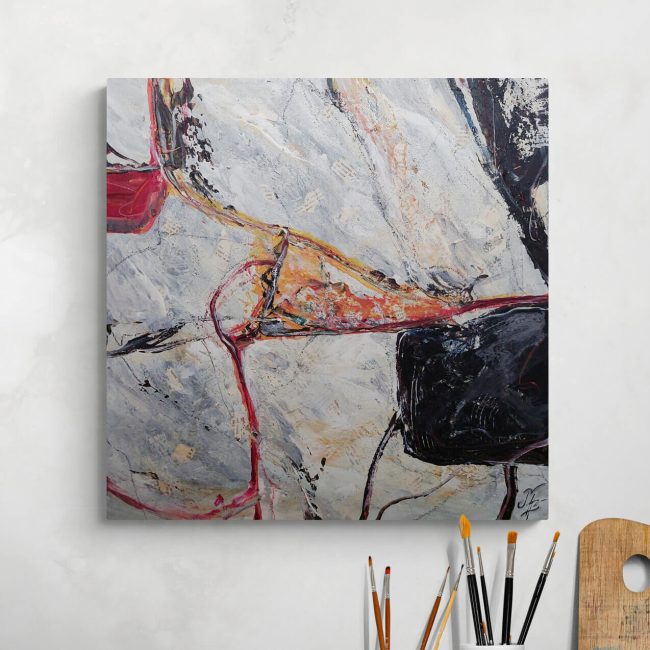
Colour sets the emotional temperature
Colour is the most immediate way a painting affects a room.
Cool colours such as blues, greys and soft greens tend to make a space feel calmer and more open. They can visually push a wall back, making a small room feel larger. They work beautifully in bedrooms, bathrooms and anywhere you want to slow down.
Warm colours such as reds, oranges, ochres and earthy browns bring energy and closeness. They can make a large, echoing room feel more intimate and welcoming. They’re often lovely in dining areas and living rooms, where people gather and talk.
Dark, deep tones add drama and depth. A dark painting on a light wall creates strong contrast and an immediate focal point. Light, airy paintings, on the other hand, can bring a sense of ease to a space that feels heavy.
A painting doesn’t need to change the colour of the whole room to change its temperature. Sometimes one canvas is enough, and it doesn’t need to depict anything to do it. Abstract art doesn’t need to look like anything to change how a space feels.
Art gives a room a focal point
Most rooms need somewhere for the eye to land. Without one, a space can feel scattered, even if everything in it is beautiful.
A large painting above a sofa, a fireplace or a bed naturally becomes that centre. The furniture seems to arrange itself around it, and the room gains a sense of order and intention.
This is why the placement of a painting matters as much as the painting itself. Hung too high, it can feel disconnected from the rest of the room. A common guideline is to place the centre of the artwork at around eye level, roughly 145–155 cm from the floor, or about 20–30 cm above the top of a sofa or headboard. Rules can be broken, of course, but this is a good place to start.

Texture brings warmth and life
Modern interiors are often full of smooth surfaces: painted walls, glass, metal, sleek furniture. They can look beautiful but feel a little cold.
Original paintings with visible texture add something different, a handmade and tactile quality. Thick layers of paint, palette knife marks and uneven surfaces catch the light and create small shadows that change throughout the day.
This is something a screen or a flat print can’t fully replicate. A textured painting feels alive in a room. In the morning it might look soft and gentle; in the evening, under warm lamps, it can look completely different. That constant, subtle change adds depth to a space.
Different rooms, different moods
Each room in a home has its own purpose, and art can support it.
Living room. This is often the place for a statement piece, something with presence that reflects your personality and starts conversations. It’s usually the room guests see first, and the one where you spend a lot of your time.
Bedroom. Here, calmer and softer works usually feel best. Gentle colours and quiet compositions, nothing too intense to wake up to. The bedroom is a place to slow down, and art can help with that.
Hallway and entrance. This is the first thing you see when you come home. A painting here sets the tone for the whole house. It can be welcoming, bright and uplifting.
Workspace. Choose a piece you can rest your eyes on between tasks. Something that lets your mind wander for a moment can be surprisingly refreshing during a long working day.
Dining area. Warm colours and lively compositions often work beautifully here, supporting conversation and the feeling of sharing a meal together.

Let the art and the room talk to each other
A painting doesn’t exist in isolation. It interacts with everything around it: the colour of the walls, the wood of the floor, the textiles, the plants, even the view from the window.
When the colours of a painting echo something in the room, such as a cushion, a rug or a vase, the space feels harmonious and carefully put together. When a painting introduces something completely new, it brings energy and a touch of surprise.
The frame, or the lack of one, plays a part too. A thin dark frame can make an artwork look sharp and contemporary, a natural wood frame adds warmth, and an unframed canvas with painted edges feels relaxed and modern.
It’s worth stepping back from time to time and looking at the room as a whole. Does the painting feel connected to the space? Does it have enough room around it? Small adjustments, like moving a lamp or a plant, can make the whole composition feel more balanced. For more practical tips on size, colour and light, see my guide on how to choose abstract art for your home.
Art makes a house feel like home
Beyond colour and composition, there’s something more personal at play.
The art we choose says something about who we are. It reflects our taste, our memories and sometimes our inner world. A room with art you love feels like yours, not like a page from a catalogue.
Paintings also carry stories. Maybe you bought one on a trip, or as a gift to yourself after a hard year, or simply because it caught your attention and wouldn’t let go. Each time you look at it, a little of that story comes back. It’s the same reason art can make us feel something long after we first see it.
That emotional layer is a big part of atmosphere. It’s why two rooms with identical furniture can feel completely different: one feels lived in and loved, while the other just feels furnished.
Small change, big difference
If you’re thinking about refreshing a room, art is one of the simplest and most effective changes you can make. You don’t need to repaint, renovate or replace furniture. Sometimes moving one painting to a different wall is enough to make a space feel new again.
Here are a few ideas to try:
– Move a painting from one room to another and notice how both spaces change.
– Lean a painting on a shelf or sideboard instead of hanging it, for a more relaxed, layered look.
– Try a bigger piece than you think you need. It often makes a room feel more confident.
– Give one painting a wall to itself, rather than surrounding it with other objects.
The atmosphere you live in matters
We spend so much of our lives at home. The atmosphere of the spaces around us affects how we feel every day: whether we rest well, whether we feel inspired, whether coming home feels like a relief.
Art is one of the gentlest and most personal ways to shape that atmosphere. It doesn’t shout. It simply stays with you, day after day, quietly changing the way a room feels.
If you’d like to see the paintings shown in this post, take a look at Green Hall II, Edge of the World and Flashback, or browse other original abstract paintings in my shop.
Have you ever noticed how one painting changed the feeling of a room? I’d love to hear about your experience.