
Why Abstract Art Doesn’t Need to Look Like Anything

Why Abstract Art Doesn't Need to Look Like Anything
“But what is it supposed to be?” It’s probably the question asked most often about abstract paintings. And honestly, I understand why people ask it.
From an early age, we learn to recognise and name things. A tree is a tree. A face is a face. When we look at a picture, our first instinct is to search for something familiar: a person, a landscape, an object we can identify.
So when a painting doesn’t offer that, it can feel confusing. Some people even feel a little frustrated, as if the artwork is hiding something from them, or as if they’re missing a secret that everyone else understands.
But what if there’s nothing to “get”? What if a painting doesn’t need to look like anything at all, and that’s the whole point?
We don’t ask music to look like something
Think about how you listen to music. When you hear a piece of instrumental music, you don’t ask what it represents. You don’t need it to sound like rain, or birds, or traffic. You simply listen, and it makes you feel something: calm, restless, nostalgic, happy.
Nobody says a melody is meaningless because it doesn’t depict a specific object.
Abstract painting works in a very similar way. Colours, shapes, lines and textures are its notes and rhythms. A sweeping gesture can feel like movement. A dark mass at the bottom of a canvas can feel heavy and grounding. A thin, nervous line can create tension. A soft wash of colour can feel like breathing out.
These are visual experiences in their own right. They don’t need to be translated into recognisable objects to mean something.


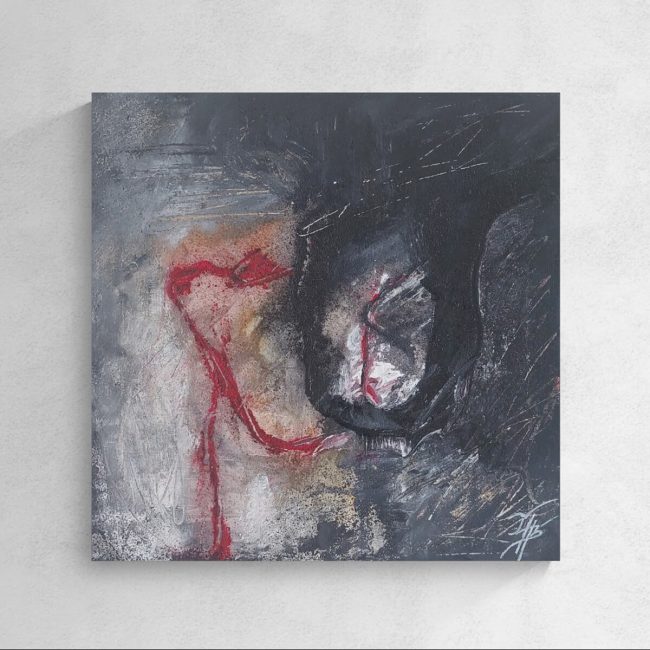

Abstract doesn’t mean “without meaning”
Sometimes people assume that if a painting isn’t of something, it must be random, or that the artist simply threw paint at the canvas without much thought.
In my experience, it’s usually the opposite.
Abstract painting involves constant decisions. Which colour goes next to which? Where should the eye go first? When does a composition feel balanced, and when does it need a little disturbance? Should this area stay quiet, or does it need more energy? And perhaps the hardest question of all: when is the painting finished?
Without a recognisable subject to lean on, every element has to work on its own. There’s nowhere to hide. If a colour is wrong, you feel it immediately. If the composition is unbalanced, no story can save it.
So yes, the meaning of an abstract painting may not be a literal one. But it’s there, in the relationships, the rhythm and the atmosphere.
What abstract art can do that realistic art can’t
Realistic painting is wonderful. It can capture a person, a moment or a place with breathtaking detail.
But some things are very hard to paint realistically. How do you paint anxiety? Or the feeling of relief after a long, difficult period? Or that strange mixture of joy and sadness when something comes to an end?
These experiences don’t have a shape. They aren’t objects. Yet they’re some of the most real things we know.
Abstract art gives us a way to approach them directly, through colour, energy and texture, without having to disguise them as a landscape or a portrait. It can speak about the inner world rather than the outer one.
That’s one of the main reasons I paint abstractly. It allows me to work with feelings and atmospheres that I simply couldn’t express through a recognisable image.

Seeing shapes is natural, and that’s fine
Here’s something interesting: even when a painting doesn’t represent anything, our brain will often try to find something in it anyway.
You might notice what looks like a face, a figure, a mountain or a bird. This is a very human tendency, the same one that makes us see animals in clouds or faces in the front of a car.
I think this is one of the most enjoyable parts of looking at abstract art. It doesn’t mean you’re looking at it the “wrong” way. If you see a storm or a forest in one of my paintings, that’s your experience of it, and it’s just as valid as mine. Our memories and emotions shape what we see, something I explored in the psychology behind our emotional connection to paintings.
In fact, I love it when someone notices something in a painting that I never saw myself. In that moment the painting becomes a meeting point between what I brought to the canvas and what the viewer brings to it.
Where an abstract painting begins
People sometimes ask how you even start a painting if there’s no subject.
For me, it often begins with a feeling, a colour combination I can’t stop thinking about, or a particular kind of movement I want to explore. Sometimes it’s a memory, or a moment in nature: the light before a storm, frost on a window, the surface of water.
But I rarely try to describe those things directly. Instead, I let them guide the choice of colours, the pace of the brushwork and the amount of texture. The painting gradually develops its own logic. At some point it starts telling me what it needs, and I follow.
By the time a piece is finished, the original starting point might be almost invisible. What remains is the atmosphere.
“My child could paint that”
It’s an old comment, and almost every abstract artist has heard it at some point.
It’s true that children often create wonderfully free, expressive images. They aren’t afraid of colour, and they don’t worry about rules. In a way, many abstract painters spend years trying to get back to that kind of freedom.
But there’s a difference between a happy accident and a body of work. A finished abstract painting is usually the result of many layers, corrections and decisions, and often of many paintings that didn’t work before it. Knowing what to keep, what to cover and when to stop is something that develops over a long time. If you’d like a look behind the scenes, here are some of the techniques that go into an abstract acrylic painting.
Simplicity can look easy. That doesn’t mean it is.
How to look at an abstract painting
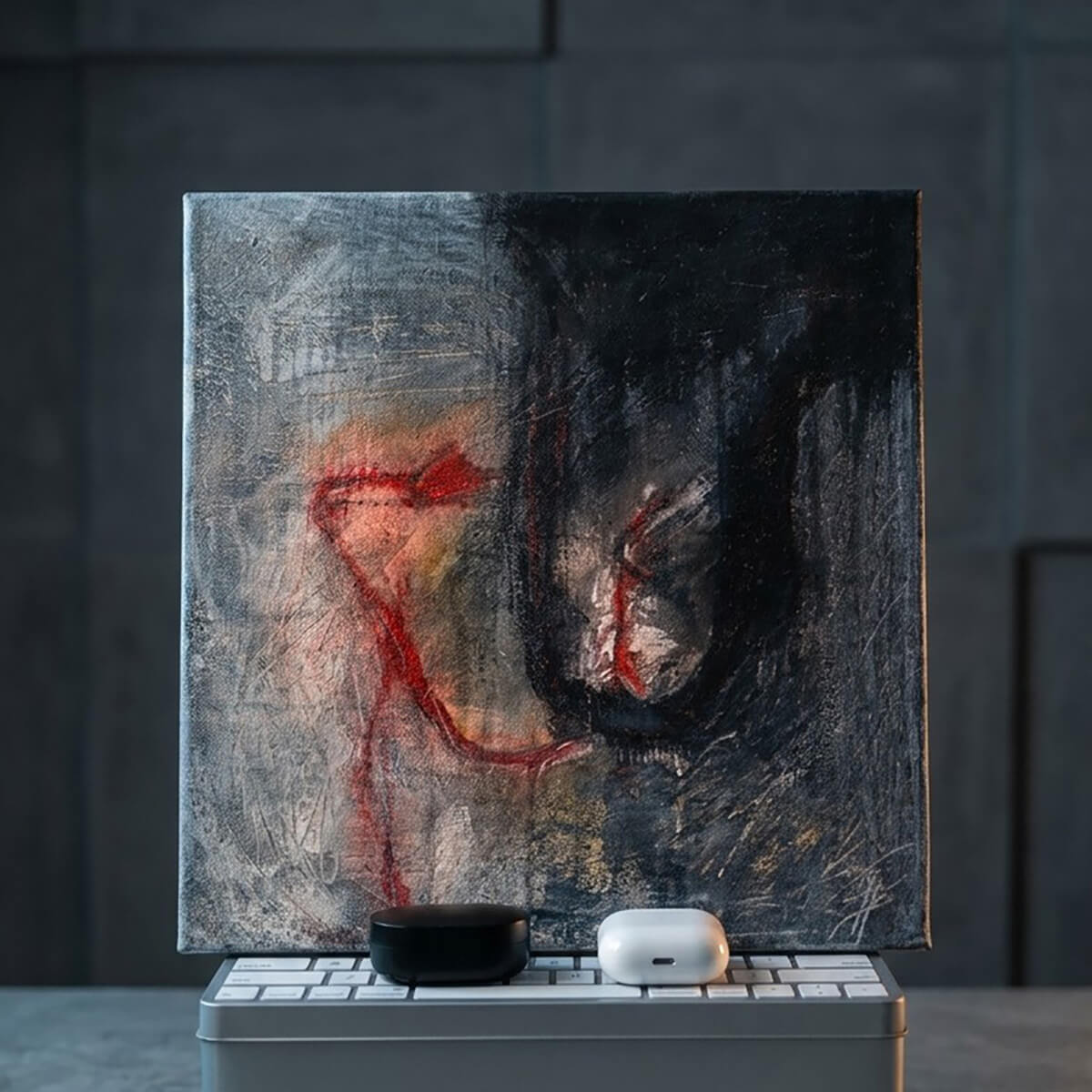
If you’d like to enjoy abstract art more, here are a few things you could try the next time you stand in front of a painting:
– Slow down. Give it a minute or two, longer than feels natural. Abstract work often reveals itself gradually.
– Notice where your eye goes first, and where it travels next. That path is part of the composition.
– Pay attention to how the painting makes you feel, rather than what it shows. Calm? Uneasy? Energised? Melancholic?
– Look closely, then step back. Texture and small details tell one story up close; the overall composition tells another from a distance.
– Read the title last. A title can be a gentle hint, but it’s an invitation, not an instruction.
Letting go of the need to understand
Perhaps the biggest shift is this: you don’t need to understand an abstract painting to enjoy it.
You can simply like the colours. You can find it calming or exciting. You can be drawn to it without any explanation at all. That experience is already complete, and it’s also the best starting point if you’re wondering how to choose abstract art for your home.
In a world where almost everything comes with instructions, labels and explanations, there’s something refreshing about an image that doesn’t tell you what to think. It gives you space to feel, to imagine and to wander.
Abstract art doesn’t need to look like anything. It just needs to make you look.
If you’re curious to see more, you can explore the paintings shown in this post, Electric Colours, Junction and The Last Drop, or browse my other original abstract paintings.
What do you see when you look at abstract art? Do you search for familiar shapes, or do you simply let the colours speak?