
How to Choose Abstract Art for Your Home

How to Choose Abstract Art for Your Home
Choosing a painting for your home can feel surprisingly difficult. With a sofa or a lamp, you compare sizes and prices, and you’re done. With art, there is no single right answer, and that is exactly what makes the decision feel so big.
Many people love abstract art but feel unsure when it comes to actually bringing a piece home. Will it suit the room? Is it too bold? Too small? What if I get tired of it after a few months?
These are completely natural questions. A painting isn’t just another object on the wall. It becomes part of your everyday life. You see it in the morning with your first coffee and in the evening when the lights are low and the day is finally quiet.
In this post I’d like to share a few simple ideas that may help you choose abstract art with more confidence. They aren’t strict rules, just things worth thinking about before you decide.
Start with how you want the room to feel
Before thinking about colours or sizes, ask yourself a simpler question: how do I want to feel in this room?
A bedroom might call for calmness and softness. A living room could be a place for conversation and energy. A home office might need something that helps you focus, or something that lets your mind wander for a moment between tasks.
Abstract art is particularly good at creating mood, because it doesn’t tell a specific story. A painting full of soft greys and misty blues can make a space feel quiet and open. A composition with strong contrasts, dark shapes and bright accents brings tension and movement. And cooler, moodier palettes don’t have to feel gloomy: I’ve written about why darker, cooler paintings aren’t necessarily sad.
When you know the feeling you’re looking for, it becomes much easier to recognise the right painting when you see it.


Trust your first reaction
Many people feel they need to “understand” abstract art before they’re allowed to like it. I don’t believe that’s true.
Often the best guide is your first, almost instinctive reaction. Do you want to keep looking? Do you come back to the same painting again and again while browsing? Does it make you curious, calm or slightly emotional without knowing why?
That quiet pull is worth paying attention to. You don’t need to be able to explain it, although there is some fascinating psychology behind why art makes us feel something. Some of the paintings people end up loving the most are the ones they simply couldn’t stop thinking about after the first glance.
On the other hand, if you feel you need to convince yourself to like a piece because it’s fashionable or because it matches the cushions perfectly, it’s probably not the one.
Colour: harmony or contrast?
Colour is usually the first thing people think about, and there are two main ways to approach it.
The first is harmony. You choose a painting that repeats some of the colours already present in the room: the tone of the floor, a textile, a plant, the wall itself. This creates a calm, connected feeling, where the artwork seems to belong to the space naturally.
The second is contrast. A painting with colours that don’t appear anywhere else in the room immediately becomes a focal point. A deep blue canvas on a light grey wall, or a warm, rusty composition in a cool minimal interior, can bring the whole space to life.
Neither approach is better than the other. It depends on whether you want the painting to blend in and support the room, or to stand out and lead it.
A small tip: instead of matching the painting exactly to your sofa, look for one or two shared tones. That’s usually enough to make everything feel connected without looking staged.

Think about size before you fall in love
Size is one of the most common reasons a painting doesn’t feel right once it’s on the wall. Usually the problem is that the artwork is too small for the space.
A small painting on a large empty wall can look a little lost. Sometimes that’s intentional. A single small piece can feel intimate and precious, like a secret you discover. But if you want the painting to anchor the room, it often needs to be bigger than you first expect.
A few practical guidelines that may help:
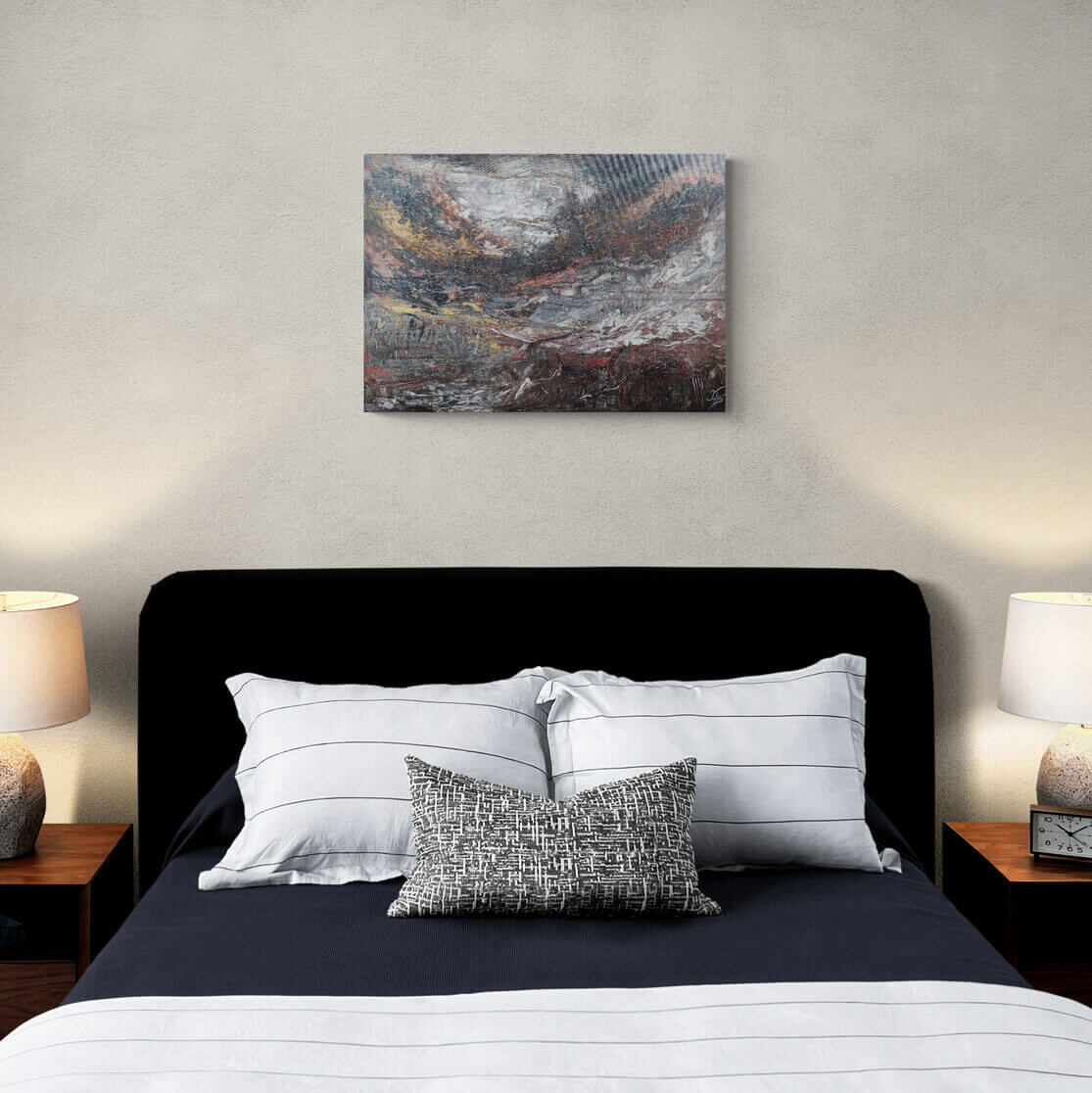
– Above a sofa or a bed, a painting (or a group of paintings) that covers roughly two-thirds of the furniture’s width usually looks balanced.
– In a hallway or a narrow space, a vertical format can make the ceiling feel higher.
– Small works often look best in places where people come close: next to a reading chair, on a shelf, on a desk or in a quiet corner.
Before buying, it can help to cut a piece of paper or cardboard to the size of the painting and tape it to the wall for a day or two. It sounds simple, but it shows you very quickly whether the scale feels right.
Consider the light
Light changes paintings more than most people realise.
Textured abstract paintings, especially, react to light throughout the day. In the morning, soft daylight can reveal delicate layers and subtle colour shifts. In the evening, warm artificial light makes some tones glow and lets others fade into shadow.
If you can, think about where the light comes from in your room. Strong direct sunlight isn’t ideal for any original artwork in the long term, but gentle indirect light is usually beautiful. A painting placed opposite a window, or lit softly from the side, will show its surface and texture much more than one hanging in a dark corner.
Texture is something you feel, not just see
One of the things I love most about original abstract paintings is texture: the visible marks of the brush or palette knife, thick layers of paint, places where colours break through one another.
In photographs, texture often looks flat. In person, it gives a painting a physical presence. It catches the light, it changes as you walk past, and it invites people to come closer. If you’re curious how these surfaces are made, I’ve shared some of my favourite techniques for creating abstract acrylic paintings.
If you’re choosing between a smooth piece and a heavily textured one, think about how you’ll experience it. A textured painting in a place you pass every day will keep revealing small details for years.
Don’t decorate around trends
Interior trends change quickly. This year’s colour of the season may feel tired in three years.
A painting, however, can stay with you for decades. It might move with you from one home to another, from one room to the next. That’s why I’d gently suggest not choosing art purely to fit a current trend or colour scheme.
Choose something that speaks to you personally, and it will fit almost any interior you create in the future, because it reflects you, not a catalogue.
One statement piece or a small collection?
There isn’t one right way to display abstract art.
A single large painting can create a strong focal point and give a room a clear sense of character. This works especially well in minimal interiors, where one piece has space to breathe.
A collection of smaller works, grouped on one wall or spread across a room, creates a more personal, gallery-like feeling. Abstract paintings often work well together even when they’re quite different, as long as they share something: a tone, a mood, or a similar kind of brushwork.
If you’re just starting out, one piece you truly love is a wonderful beginning. Collections tend to grow naturally over time.
An original painting is more than decoration
Finally, I think it’s worth remembering that an original painting is more than a decorative element.
It’s a piece of someone’s time, thoughts and emotions. Every layer was a decision. Every mark was made by hand. When you bring an original artwork into your home, you bring a small part of that story with it, and then you add your own.
Over time, paintings collect memories. You remember where you found them, why you chose them, what was happening in your life at that moment. They become part of the home in a way that very few objects do.
So take your time. Look at different works. Notice which ones stay with you. And when a painting makes you stop, even for a moment, that’s usually a good sign.
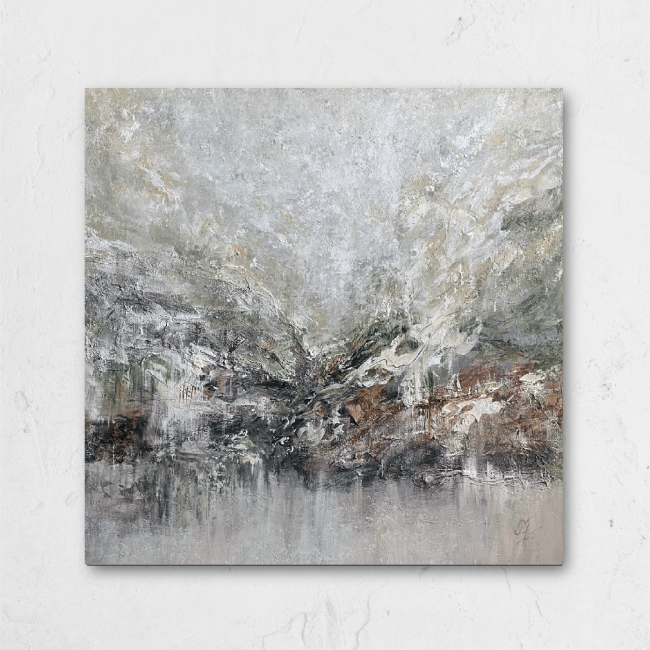
If you’d like to see the paintings shown in this post, you can find Gates, Autumn Breath and Underground in my shop, along with other original abstract paintings. And if you’re not sure which piece would suit your space, feel free to get in touch. I’m always happy to help.
What about you? How do you usually choose art for your home: with your head, or with your heart?