Why Does Art Make Us Feel Something? The Psychology Behind Our Emotional Connection to Paintings

10 WhyWhy The Psychology Behind Our Emotional Connection to PaintingsTechniques for Creating Stunning Abstract Acrylic Paintings
Why do some paintings stay in our minds?
Have you ever looked at a painting and felt something you couldn’t quite explain?
It might remind you of a place you’ve never visited, bring back a distant memory, or create a feeling of calmness without any obvious reason. Sometimes, a painting can even make you uncomfortable. And yet, you find yourself looking at it again.
Art has a curious ability to reach us without using words. It can communicate through colours, shapes, textures and contrasts, leaving space for our own experiences to become part of the artwork.
But why does this happen? And why can two people look at exactly the same painting and feel completely different things?
We don’t see paintings with our eyes alone
When we look at a work of art, we don’t approach it as blank slates. We bring our memories, experiences, expectations and current emotional state with us.
A painting may remind one person of a peaceful summer evening, while another sees loneliness or nostalgia in the very same colours.
This is one of the most interesting aspects of abstract art. Unlike a realistic portrait or landscape, an abstract painting doesn’t necessarily tell us what we should see. It gives us visual elements and allows our minds to create their own connections.
A vague shape might resemble a human figure. A particular combination of colours might evoke a familiar atmosphere. A rough texture could remind us of something from nature, even if the artist never intended that association.
In a way, looking at art becomes a personal conversation between the artwork and the viewer.
How colours influence our emotions
Colour is often the first thing we notice in a painting. It can influence the atmosphere of an artwork before we even begin to understand its composition.
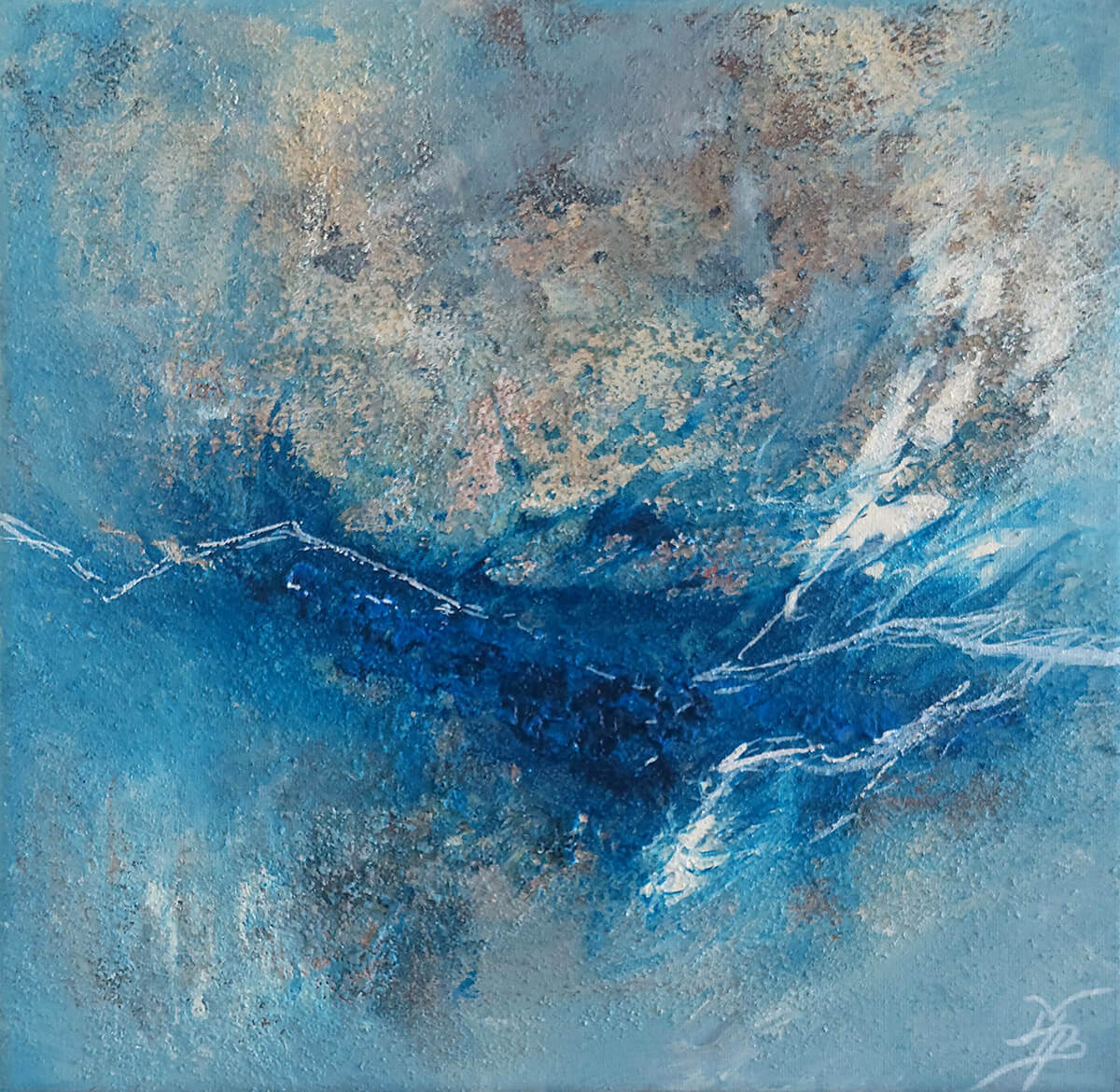
Blue is frequently associated with calmness, distance, sadness or reflection. Red can suggest passion, danger, energy or anger. Yellow may feel warm and optimistic, but in a different context it can also appear unsettling.
However, colour psychology isn’t a universal set of rules. The same shade can evoke completely different associations depending on someone’s memories, culture and personal experiences.
For example, a painting dominated by cool blues might feel peaceful to one viewer and melancholic to another. Neither interpretation is necessarily wrong.
I often find myself drawn to cooler colours, especially blues, greys and muted tones. They allow me to explore atmosphere, depth and emotion without having to explain everything through recognisable objects.
Why can a painting make us feel sad?
Not every artwork is meant to make us happy. Some paintings explore difficult emotions, uncertainty, tension or vulnerability.
And perhaps that’s exactly why they can be so meaningful.
We often expect art to be beautiful, decorative or uplifting. But beauty doesn’t always have to be comfortable. Sometimes an artwork becomes interesting precisely because it makes us pause, question something or confront a feeling we’d rather avoid.
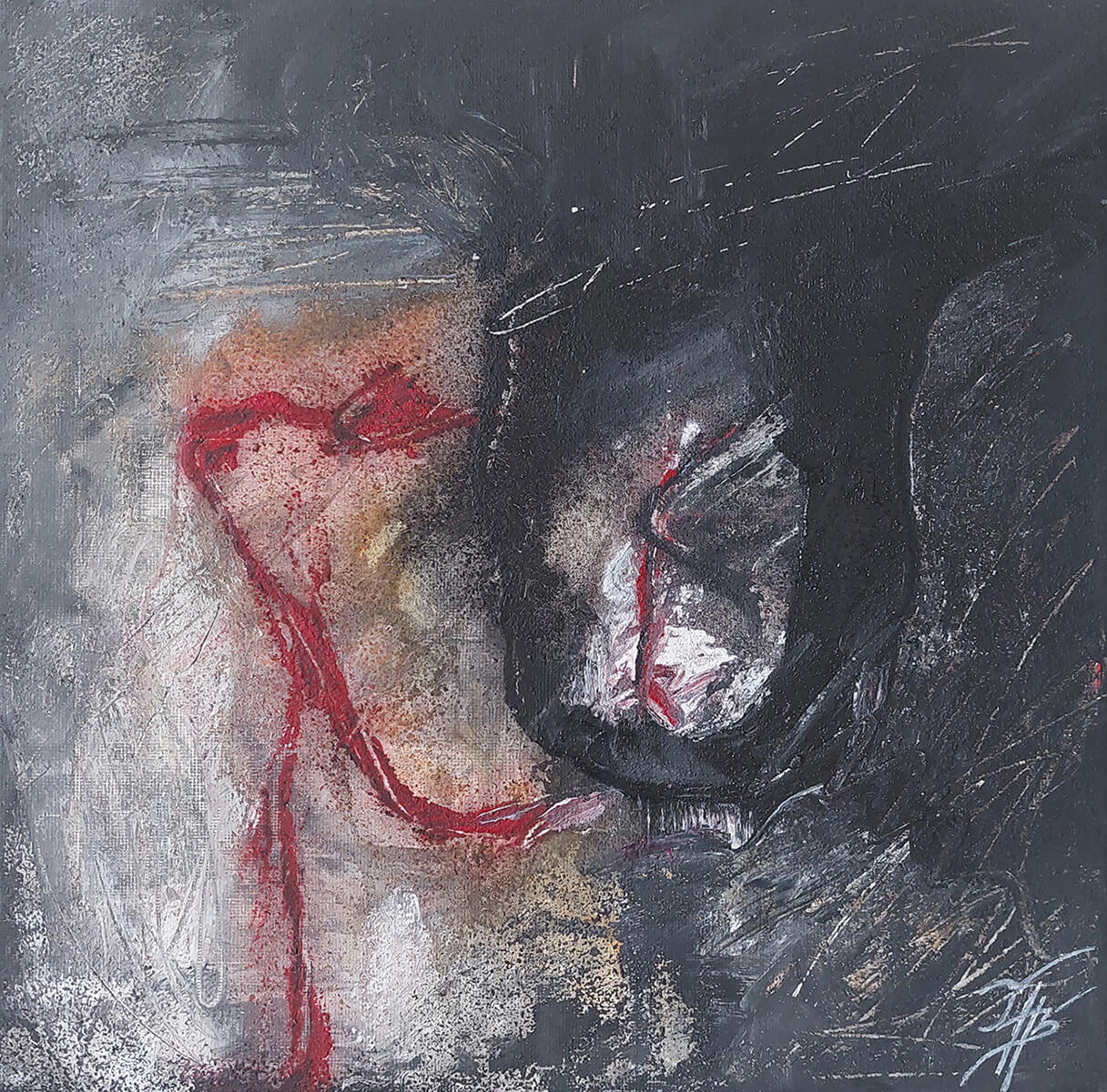
Consider an artwork with dark colours, restless lines and rough textures. One person might interpret it as anger or despair. Someone else might see strength, transformation or the determination to keep going.
The artist may have had a completely different feeling in mind.
This doesn’t make any of these interpretations less valuable. Art doesn’t always need to provide answers. Sometimes its purpose is simply to make us feel something.
The role of personal memories
Have you ever smelled a particular perfume and suddenly remembered someone you haven’t seen in years? Or heard a song that instantly transported you to another period of your life?
Visual art can work in a similar way.
A certain colour combination, shape or texture may trigger an association that has nothing to do with the actual subject of the painting.
For example, a soft, misty composition might remind someone of childhood mornings, while another person might associate it with a lonely walk through an unfamiliar city.
These reactions are not necessarily conscious. We might simply feel attracted to a painting without knowing why.
This is also why choosing art for our homes can be such a personal experience. We aren’t always looking for something that matches the furniture. Sometimes we are looking for something that reflects a feeling we recognise but cannot put into words.
Can art reveal something about ourselves?
Perhaps one of the most interesting things about looking at art is that our reactions can tell us something about our own perspectives.
Imagine standing in front of an abstract painting. You notice a dark shape and immediately interpret it as something threatening. Another viewer sees the same shape as protective or comforting.
The painting hasn’t changed. Only the person looking at it has.
Of course, our interpretation of a single artwork isn’t a psychological test, and it shouldn’t be treated as a diagnosis. But paying attention to our reactions can be a useful way of reflecting on what attracts us, what unsettles us and what we find meaningful.
Sometimes, the artwork becomes a starting point for thoughts we hadn’t consciously explored before.
There is no single correct way to understand art
One of the things I appreciate most about abstract painting is the freedom it gives both the artist and the viewer.
When I create a painting, I may begin with a particular emotion, atmosphere or thought. But once the artwork is finished and someone else encounters it, their interpretation becomes part of its story.
I don’t believe every painting needs a detailed explanation. Sometimes explaining too much can take away the freedom to experience it in your own way.
A painting can be sad and beautiful at the same time. It can feel chaotic but somehow comforting. It can remind you of something you cannot quite remember.
And perhaps that’s the point.
Art doesn’t always have to tell us what to think. Sometimes it simply gives us a reason to stop, look closer and notice what is happening inside us.
What about you? Have you ever looked at a painting and felt an emotion that surprised you? Did it remind you of a particular memory, person or moment in your life?